Holy Fun: The Peach Jolly Rancher

IMG_5605.JPG

– Seattle, Washington (Ballard)

Do you remember your first Jolly Rancher? The candy that could make your day or break your teeth is one that I’ll never forget. It's funny being 38 years old and a father of two that somehow lately memories that have been tucked away in the outskirts of my mind are being dislodged. Some are painful, some are beautiful, and some are fun, and some are holy. This memory is sacred and fun. Those things can and should go together, you know? Don't let anyone lie to you and tell you that holiness is the enemy of fun. Holiness is no more the enemy of fun than Mickey is the archenemy of Pluto. They belong together. In fact, when one exists without the other, we end up sounding like a weary Solomon rather than a rejoicing Siemon in the temple cradling the Messiah or a Mary who knows how to pick the good portion and find a seat close to the Savior. 

I remember being about 9 years old in Panama City Beach on our family vacation. We loaded up in my mom’s Aero Star minivan and made the 6 or so hour trek down to what some call the “Redneck Riviera.” Maybe I was too young to notice or care for the snarky comment about where we went on vacation. My mom and brother were on the beach, and my dad and I were to go grab something from our condo. My dad had the 80s vibe down. He was wearing short green swimming trunks, a white v-neck, and his flip-flops. He also donned his aviators with the kind of swag that American Apparel today attempts to recapture. We made our way to the lobby and boarded the elevator. It smelled of bleach, and there was sand in our sandals. You know that gritty-Florida-vacation-elevator-feel? It’s as good as Christmas morning or a Friday afternoon in the sun with a good book, friend, or both. 

When we arrived on the seventh floor, we took a right, and three doors down was the Early palace for the week. My dad reached into his right pocket and pulled out the key and opened the door. The bone-chilling air conditioning rushed out upon us like the wind of Pentecost. Nobody spoke in tongues and yet, I was standing in the middle a miracle and didn't know it. How do we not know it right then and there? Even the disciples didn't recognize the Savior on the Emmaus road, for goodness sake. 

For that brief moment in time, which lasted no longer than any other time a father and son walk through a door, I now believe that moment was filled to the brim with something sacred. As sacred as anything I've ever heard about anyway. Be it  Moses and the burning bush or Elijah's calling down fire or whatever other fantastical scenes… That fraction of a second in my memory is like a grain of sand under my toes. We were utterly still I could not see his eyes. Instead, I saw myself in the reflection of his sunglasses, a shirtless little boy, gazing up like those resurrection-struck-buffoons at the ascension of our Lord.

I looked in his hand, and he also had two Jolly peach Ranchers. I’d never seen one. I don’t know how I’d lived nine whole years on God's green earth and never actually come across one of these marvelous little creations. My dad handed one to me and said, “Here. Eat this. It’s peach.”   I took it, opened it up, and popped it into my mouth. He said, “Don’t bite down! It’ll break your teeth!” I listened. For maybe the first time in my life, I listened to my dad, and I’m glad I did. 

To this day that was the best Jolly Rancher I ever had. I don't think I've had one since I was in high school. I did try grape and watermelon, and all the others. But the peach one… in the doorway… with the ghost of Pentecost blowing… and my reflection in his aviators…. peach is the best Jolly Rancher. 

Leaving Social Media

20213895_1919278818321442_5336945088067010560_n.jpg

– Lake Kachees, Okanogan-Wenatchee National Forest

Hey everyone! After giving it a good bit of thought, I've decided to walk away from social media for the foreseeable future. I just feel like it would be good for me. However, I do plan on updating my blog, sermons, and food posts regularly.  

I would love to stay in touch with all of you. Believe it or not, I'm good at responding to emails. You can contact me here on my website or at Alex@redemptionchurchseattle.com.

Love to you all! 

Abba's Child,

Alex

Timothy Keller on Being Known and Loved in Marriage

keller.png

“To be loved but not known is comforting but superficial. To be known and not loved is our greatest fear. But to be fully known and truly loved is, well, a lot like being loved by God. It is what we need more than anything. It liberates us from pretense, humbles us out of our self-righteousness, and fortifies us for any difficulty life can throw at us.”


Timothy Keller, The Meaning of Marriage: Facing the Complexities of Commitment with the Wisdom of God, 101. 

Brennan Manning Asks 15 Questions to Examine the Conscience

brennan manning 1.jpg

I'm slowly reading through Brennan Manning's very first book, Prophets and Lovers: In Search of the Holy Spirit. Like everything he wrote, it is wonderful. I heard him mention these questions in sermons on a number of occasions. Seeing them again this morning... well... they're as sobering as they ever were. In 1976, Brennan was asking:

  1. Have I missed the message of Chicago, Birmingham, and Detroit and failed to take the initiative in working for social justice?
  2. In reading the daily paper and seeing a black youth being torn at by a police dog, a black priest having Catholics refuse to receive Communion from him, wretched living conditions in ghettos, full grown men still unable to get jobs, and youth of every race and color wasting away from alcohol, sex and narcotics, have I ever felt real anguish for the misery of others?
  3. Have I had habitual contempt for others: less educated people, people of different national, racial or economic groups? 
  4. Dismissed all old people as medieval ("My father is 10,000 years old," said a young co-ed) and never tried to make them feel their worth as persons and their dignity as members of the human community?
  5. In any way stifled the personal development of another? 
  6. Sought to be respected without respecting others?
  7. Often kept others waiting? 
  8. Forgotten or not kept a date?
  9. Been difficult for others to reach or too busy to put myself at their disposal?
  10. Not paid attention to the person speaking to me? 
  11. Refused to become involved in the troubles of others and dismissed them with a pat reassurance, "Don't worry. It will work out."? 
  12. Kept silent out of human respect when different personalities were pulverized? ("We do not have the right to be silent watchdogs and silent sentinels," wrote DeFoucauld, "We must cry out when we see evil being done").
  13. Seen only those whose friendship might prove profitable?
  14. Blackened the character of anyone by harmful remarks (false or true)?
  15. Betrayed a trust, violated a confidence or involved myself in others' affairs through indiscreet words and actions?

Trinity: Persons, Not 'Parts'

The very first course I had in Systematic Theology was in 2001. I was a student at North Greenville University in Tigerville, South Carolina. My teacher was a gentleman named Walter Johnson. Dr. Johnson was a tall man, well-bearded, and wore round glasses. (Standard theologian attire). He was very bright and had a wonderful way of helping us students really grasp the content of what we were studying day in and day out. Dr. Johnson was the first person to press me (and probably most of my classmates) to think and articulate myself much more specifically than I had up to that point regarding the Christian faith. Like my cluttered shed out back; there were Bible words that were in my vocabulary that needed attention and I suppose this will always be the case. Some of those words needed to be thrown out (Rapture!) Others needed shaping up. There were also a few (not many!) that were perfectly fine, in need of no repair.

For example, God. When I'd say "God", it needed some shaping up. I mostly meant God the Father. This was good, not great. It was good because when I said "God" I was not thinking of Allah, Vishnu, the Dali Lama, an impersonal space deity, the Flying Spaghetti Monster, or any other religious idea about the divine. I was vaguely thinking of the God described in the Old and New Testaments. This was good but still wildly incomplete (and I fully acknowledge that to this day, my thoughts remain incomplete. I cannot and will never be able to think at once about all of who God is, what he has done, or will do. He is omniscient. I can't find my keys on a regular basis). Though I believed in Christ his Son and the Holy Spirit, it wasn't natural for me to think much of the Trinity. One day Dr. Johnson pointed this idea out to me in class. I said, "Well, yes. Of course, I believe in the other parts of God." He stopped, looked at me, and kindly said,

““Parts? What do you mean by ‘parts’? God doesn’t have ‘parts.’ God is a Person and Persons. God doesn’t come in ‘parts.’” ”


That may sound a bit pedantic to some. (And believe me, some theologians appear to have minored in pedantic studies). But he wasn't being unnecessarily punctilious. He was helping me big time. He was good theology. That rainy, Thursday South Carolina morning at 11:00 A.M. he was teaching me to think about what the Bible says and to use words that the Bible itself uses to describe God. "Parts" wasn't the right word to use when describing God. Person(s)? Now that's a good word. A better word. A truer word. A clearer word.

The God of the Christian faith is a personal God, a knowable God, a relational God. Ontologically speaking, the Trinity is a loving, harmonious, glorious relationship (perichoresis). God relates not only amongst the members of the Trinity but to creation in general, and to his children uniquely. God isn't to be broken into parts like some impersonal, nonliving, machine that can be disassembled, studied, and put back together. God is eternal, lacking nothing, unchanging, and has no weakness in himself... with the exception of the ministry of Christ; in which the eternal Son humbled himself ... but that discussion belongs over in the field of Christology... and see? We're off to another doctrine altogether! Isn't theology fantastic?!

In short, be reminded today that God is personal, relational, and beautiful. In His grace, he has reached out to us. Give yourself a full, undistracted 60 seconds to sit still and be mindful of our great God who knows us and invites us to know him.


Oh... and here's the great Dr. J. 

1_walter_johnson_color_web.jpg

It's You I Like by Fred Rogers

lead_960.jpg

It’s you I like,
It’s not the things you wear,
It’s not the way you do your hair–
But it’s you I like
The way you are right now,
The way down deep inside you–
Not the things that hide you,
Not your toys–
They’re just beside you.

But it’s you I like–
Every part of you,
Your skin, your eyes, your feelings
Whether old or new.
I hope that you’ll remember
Even when you’re feeling blue
That it’s you I like,
It’s you yourself,
It’s you, it’s you I like.

Henri Nouwen: A Friend Who Cares

henry-nouwen.jpg
“When we honestly ask ourselves which person in our lives mean the most to us, we often find that it is those who, instead of giving advice, solutions, or cures, have chosen rather to share our pain and touch our wounds with a warm and tender hand. The friend who can be silent with us in a moment of despair or confusion, who can stay with us in an hour of grief and bereavement, who can tolerate not knowing, not curing, not healing and face with us the reality of our powerlessness, that is a friend who cares.”
— Henri Nouwen, Out of Solitude: Three Meditations on the Christian Life, 38.

G.K. Chesterton on the Easter Garden Jesus

Gilbert_Chesterton.jpg

"On the third day the friends of Christ coming at daybreak to the place found the grave empty and the stone rolled away. In varying ways they realized the new wonder; but they hardly realized that the world had died in the night. What they were looking at was the first day of a new creation, with a new heaven and a new earth; and in a semblance of the gardener God walked again in the garden, in the cool not of the evening but of the dawn.”  


G.K. Chesterton, The Everlasting Man, 192.

John Stott on "Where's the Salt?"

john-stott-1.jpg

“God intends us to penetrate the world. Christian salt has no business to remain snugly in elegant little ecclesiastical salt cellars; our place is to be rubbed into the secular community, as salt is rubbed into meat, to stop it going bad. And when society does go bad, we Christians tend to throw up our hands in pious horror and reproach the non-Christian world; but should we not rather reproach ourselves? One can hardly blame unsalted meat for going bad. It cannot do anything else. The real question to ask is: Where is the salt?” 


John Stott, The Message of the Sermon on the Mount, 65.

Charles de Foucauld: Prayer of Abandonment

blessedcharlesdefoucauld.png

Father,
I abandon myself into your hands; do with me what you will.
Whatever you may do, I thank you:
I am ready for all, I accept all.
Let only your will be done in me, and in all your creatures.
I wish no more than this, O Lord.

Into your hands I commend my soul;
I offer it to you
with all the love of my heart,
for I love you, Lord,
and so need to give myself,
to surrender myself into your hands,
without reserve,
and with boundless confidence,
for you are my Father.

Charles Spurgeon on Preaching the Law and Gospel in Hopes of Seeing Conversions

1200px-Charles_Haddon_Spurgeon_by_Alexander_Melville.jpg

"... what else should be done if we hope to see conversions? Assuredly we should be careful to preach most prominently those truths which are likely to lead to this end. What truths are those? I answer we should first and foremost preach Christ and him crucified. Where Jesus is exalted souls are attracted – "I, if I be lifted up will draw all men unto me." The preaching of the cross is to them that are saved the wisdom of God and the power of God. The Christian minister should preach all the truths which cluster around the person and work of the Lord Jesus, and hence he must declare very earnestly and pointedly the evil of sin, which created the need of a Saviour. Let him show that sin is a breach of the law, that it necessitates punishment, and that the wrath of God is revealed against it. Let him never treat sin as though it were a trifle or a misfortune, but let him set it forth as exceeding sinful. Let him go into particulars, not superficially glancing at evil in the gross, mentioning various sins in detail, especially those most current at the time: such as that all-devouring hydra of drunkenness, which devastates our land; lying, which in the form of slander abounds on all sides; and licentiousness, which must be mentioned with holy delicacy, and yet needs to be denounced unsparingly. We must especially reprove those evils into which our hearts have fallen, or are likely to fall. Explain the ten commandments and obey the divine injunction: "Show my people their transgressions, and the house of Jacob their sins." Open up the spirituality of the law as our Lord did, and show how it is broken by evil thoughts, intentions, and imaginations. By this means many sinners will be pricked in their hearts. Old Robbie Flockhart used to say, "It is of no use trying to sew with the silken thread of the gospel unless we pierce a way for it with the sharp needle of the law." The law goes first, like the needle, and draws the gospel thread after it: therefore preach concerning sin, righteousness, and judgement to come. Let such language as that of the fifty first Psalm be explained: show that God requireth truth in the inward parts, and that purging with sacrificial blood is absolutely needful. Aim at the heart. Probe the wound and touch the very quick of the soul. Spare not the sterner themes, for men must be wounded before they can be healed, and slain before they can be made alive. No man will ever put on the robe of Christ's righteousness till he is stripped of his fig leaves, nor will he wash in the fount of mercy till he perceives his filthiness. Therefore, my brethren, we must not cease to declare the law, its demands, its threatenings, and the sinner's multiplied breaches of it."


Charles Haddon Spurgeon, Lectures to My Students, 337-338.

Robert Capon on the Reformation

32531.jpg

"The reformation was a time when men went blind, staggering drunk because they had discovered, in the dusty basement of late medievalism, a whole cellar full of fifteen-hundred-year-old, two hundred proof grace – bottle after bottle of pure distillate of Scripture, one sip of which would convince anyone that God saves us single-handedly. The word of the Gospel–after all those centuries of trying to lift yourself into heaven by worrying about the perfection of your bootstraps–suddenly turned out to be a flat announcement that the saved were home before they started. Grace has to be drunk straight: no water, no ice, and certainly no ginger ale, neither goodness, nor badness, nor the flowers that bloom in the spring of super spirituality could be allowed to enter into the case.”


Robert Farrar Capon, Between Noon and Three: Romance, Law, and the Outrage of Grace, 109-110.

R.C. Sproul on the Bible

80202.jpg

“I think the greatest weakness in the church today is that almost no one believes that God invests His power in the Bible. Everyone is looking for power in a program, in a methodology, in a technique, in anything and everything but that in which God has placed it—His Word. He alone has the power to change lives for eternity, and that power is focused on the Scriptures.” 


R.C. Sproul, The Prayer of the Lord, 101. 

Brennan Manning on Jesus' Feelings

Brennan-Manning-391x400@2x.jpg

“We have spread so many ashes over the historical Jesus that we scarcely feel the glow of his presence anymore. He is a man in a way that we have forgotten men can be: truthful, blunt, emotional, non-manipulative, sensitive, compassionate–his inner child so liberated that he did not feel it unmanly to cry. He met people head-on and refused to cut any deal at the price of his integrity. 

The Gospel portrait of the beloved Child of Abba is that of a man exquisitely attuned to his emotions and uninhibited in expressing them. The Son of Man did not scorn or reject feelings as fickle and unreliable. They were sensitive emotional antennae to which he listened carefully and through which he perceived the will of his Father for congruent speech and action.”

– Brennan Manning, Abba's Child: The Cry of the Heart for Intimate Belonging, 71. 

On Baptism

ocean-water-waves-wallpaper-4-600x400.jpg

Click here to sign up to be baptized during our worship service this Sunday, January 28! 

____________________


For anyone who would follow the Lord Jesus, baptism is a commandment. Like all of his other commands to disciples – they are just that commandments, not suggestions. And if we understand who he is and what he’s done then we can agree with St. John's and say from the heart “his commands are not burdensome” (1 John 5:3).


The glorious sacrament of baptism speaks directly to who God is and what he has done in Christ, through the Holy Spirit for the sake of the Church! Here at Redemption Church we rejoice from the heart each time a brother or sister repents to Jesus, trusts in Jesus, and follows after Jesus, our Lord and Savior. 


The New Testament teaches us much about the meaning of baptism. Here are three things we gleam from the gospel, history (Acts), and the words of St. Paul to the church at Corinth.


GOING PUBLIC

Jesus commanded that all who would come after him as his disciples are to follow him in being baptized. This action of being submerged in water and being raised out of the water is public declaration that one has been plunged into a living relationship with the Triune God, remembering that we are “baptized in the name of the Father, Son, and Holy Spirit” (Matt. 28:19). Notice here that Jesus says “name” and not “names.” Why because of the Oneness and Three-ness of our God.

"Baptism was to conversion something like what the engagement ring is to many engaged couples in modern Western society; the official, public declaration of the commitment."*
 

As a church family, we joyfully heed Paul's instructions to "do good to all people, especially to those who belong to the family of believers" (Gal. 6:10). 


Washing of sins

In addition to a living relationship with the Triune God, baptism also is a picture of a particular kind of cleansing; a cleansing of sin. Look at this beautiful statement from Ananias to Paul upon his conversion to Christ, “And now what are you waiting for? Get up, be baptized and wash your sins away, calling on his name” (Acts 22:16). Notice the close connection between baptism and "calling upon his name." Australian scholar, David Peterson says,

“Outward washing with water expresses the cleansing from sin that is proclaimed in the gospel and received by faith sacramentally in baptism.”* 

We are now cleansed before God through Jesus. Baptism points to this reality.


DEATH, BURIAL, AND Resurrection depicted

Nearing the end of his letter to the Corinthian church, in his lengthy treatment of the resurrection, Paul writes,

“For I delivered to you as of first importance what I also received: that Christ died for our sins in accordance with the Scriptures, that he was buried, that he was raised on the third day in accordance with the Scriptures…” (1 Cor. 15:3-4).
 

Baptism is a picture of Good Friday and Easter! When someone goes into the water, they’re declaring that their sins are buried with Christ. When someone comes up out of the water, they’re identifying with the resurrected Lord Jesus!


WOMB & TOMB

There is a saying from the early church that can serve to help us better understand what water baptism is and what it represents. Sofia Cavalletti, a woman who lived in Rome and worked with young children on their spiritual formation, writes in her book Living Liturgy: Elementary Reflections:


“The catechumens [Christian converts awaiting baptism] went down into the baptismal pool, which was considered both the tomb of the old person and the motherly womb of the church, which gave new birth to the new person. Going into the pool was like going down into the tomb, and coming up out of the pool was the return to a new life, the life of the risen Christ.”
 

So, if you walk into your church and you see the baptismal font, think to yourself, from death to life. You see, when you're baptized, you’re in a sense reaching back in time to hold the hands of the saints who have gone before us, and remembering the stark reality that our old lives with all of our sin and folly are buried in the tomb, and by the grace of God, we emerge to live new lives from the womb as the people of God.


The baptismal font is the tomb and the womb.


So if you’re a believer in Jesus and are ready to take your next step of faith and be baptized, please fill out the form and one of our pastors will follow up with you right away. 


____________________________

[1] Ryken, Wilhoit, and Longman III, gen. eds., “Baptism,” Dictionary of Biblical Imagery, 73. 

[2] Peterson, D. G. (2009). The Acts of the Apostles (p. 603). Grand Rapids, MI; Nottingham, England: William B. Eerdmans Publishing Company. 

[3] This article is a brief summary of the chapter entitled "Baptism" in my book The New Believer's Guide to the Christian Life: What Will Change, What Won't, and Why it Matters.

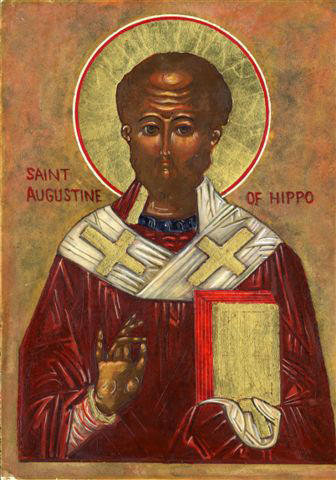
St. Augustine: The Pear Thief

static1.squarespace.jpg

We’ve all done it. From the least to the greatest, the dumbest to the smartest, the most vile to the most honorable – we have all taken that which did not belong to us. 

St. Augustine, (354-430 A.D) the Bishop of Hippo (North Africa, Algeria) was no exception. Prior to his conversion to Christ, he lived a wild life, indulging the flesh in every way. Writing book two of his legendary “Confessions”  his mid-40s, he reflects on his teenage years back when he ran with a few friends that consistently found themselves getting into trouble. Can anyone relate? I know I can. The boys moved in together and called themselves something to the effect of “The Destructors.”*

One evening, The Destructors we’re up to no good. Across the way from Augustine’s parents home was an orchard belonging to someone else. The boys decided to help themselves to some pears. These boys weren't Robin Hoods - stealing to give to the poor. They didn't steal out of hunger. They stole but simply because it was wrong. There was a law to break and they broke it. They simply threw them away to some nearby hogs. 

Augustine writes:

We carried off a huge load of pears, not to eat ourselves, but to dump out to the hogs, after barely tasting some of them ourselves. Doing this pleased us all the more because it was forbidden. Such was my heart, O God, such was my heart–which thou didst pity even in that bottomless pit. Behold, now let my heart confess to thee what it was seeking there, when I was being gratuitously wanton, having no inducement to evil but the evil itself.

Stealing pears to give to hogs may not seem like a major sin compared to countless horrendous acts through world history. However, this "small" sin gave an excellent read on his (and our) heart. I'm under the impression that the Holy Spirit coupled with midlife reflection tends to put things in perspective. As he thought about his friends, the laughing, the pears, the thought of getting away with something, and the hogs laid up against the grace of God, he saw his heart for what shape it really was in when Jesus saved him. 

It was foul, and I loved it. I loved my own undoing. I loved my error–not that for which I erred but the error itself. A depraved soul, falling away from security in thee to destruction in itself, seeking nothing from the shameful deed but shame itself.

It was a love of sin.

We've all been there. Even those we refer to as "Saints." 

How'd he go from sinner to saint? The same way you and I do. Through the truth that where sin abounded grace abounded all the more (Romans 5:20).


Justo González, The Mestizo Augustine: A Theologian Between Two Cultures, 34.

Silence in Seattle

IMG_2899.JPG

Silence in Liturgy

Nearly every week in our corporate worship gatherings at Redemption Church we intentionally place a time of silence into our liturgy. Yes, a moment of to be completely silent, with no agenda before Almighty God. Why on earth would we do this? Isn't church already the most awkward hour of our lives? We read from a book a few thousand years old, sit on wooden pews, gaze up at stained glass, in reverence of our God, who we cannot physically see! What does sitting in silence actually accomplish? What's the purpose? How is it pragmatic?

The answer is very simple. 

Practicing silence in Seattle flips our busy routine on it's head. Here in our ever-growing, fast-paced, ever-changing city, most people never stop for a full 60 seconds to just be still. As Seattleites, we wake up looking at our phones. We talk all day in conversations, are on our phones as we head to another meeting, another lunch, another meal, and then make it home, turn on Netflix, and stare out our phones until it's time for bed. Then it starts over.

It is as though we are unwilling and unable to sit completely still with our souls before Almighty God. The implications affect not only our understanding of who God is but we also end up not really knowing ourselves. You and I are very complex and complicated beings. The only way we can really know ourselves; what makes us tick, what makes us happy or sad, or what gives us meaning, purpose, and direction is the discipline of sitting still long enough and to pay attention to the voice of the Holy Spirit, calling us deeper still as he forms childlike faith in us as the children of God.

We are silent in our liturgy not because we don't know what to do with 60 seconds of time. We are silent because we think we always think we do know what to do with 60 seconds of time. It is in the silence that things, people, events, and desires, all come to mind that otherwise remain buried in the busyness of life. As they come to our minds, we give them to our God. 

In short, silence is a gift.

Silence at Home

When was the last time you tried sitting in total silence on your own? That is, without a Bible, a phone, a pen and journal, but simply just you and your awareness of the God who is present? I've noticed that in those moments of taking slow deep breaths and becoming aware of my Abba who loves me, likes me, and is quite fond of me, that my priorities shift, confession flows freely, and that self hatred, doubt, and skepticism float off. The result is worship of God, acceptance of self, and heartfelt tenderness towards others in born. God accomplishes and teaches more in 60 seconds of silence than what anyone could gain in 60 hours of theological research. 

Perhaps you could try just 5 minutes today? For some, 5 minutes will fly by. But for many of us, those 5 minutes require training the mind to stay present, the heart to stay engaged, and the body to stay completely still. 

Attention, all! See the marvels of God!
    He plants flowers and trees all over the earth,
Bans war from pole to pole,
    breaks all the weapons across his knee.
“Step out of the traffic! Take a long,
    loving look at me, your High God,
    above politics, above everything.”

– Psalm 46:8-10, The Message